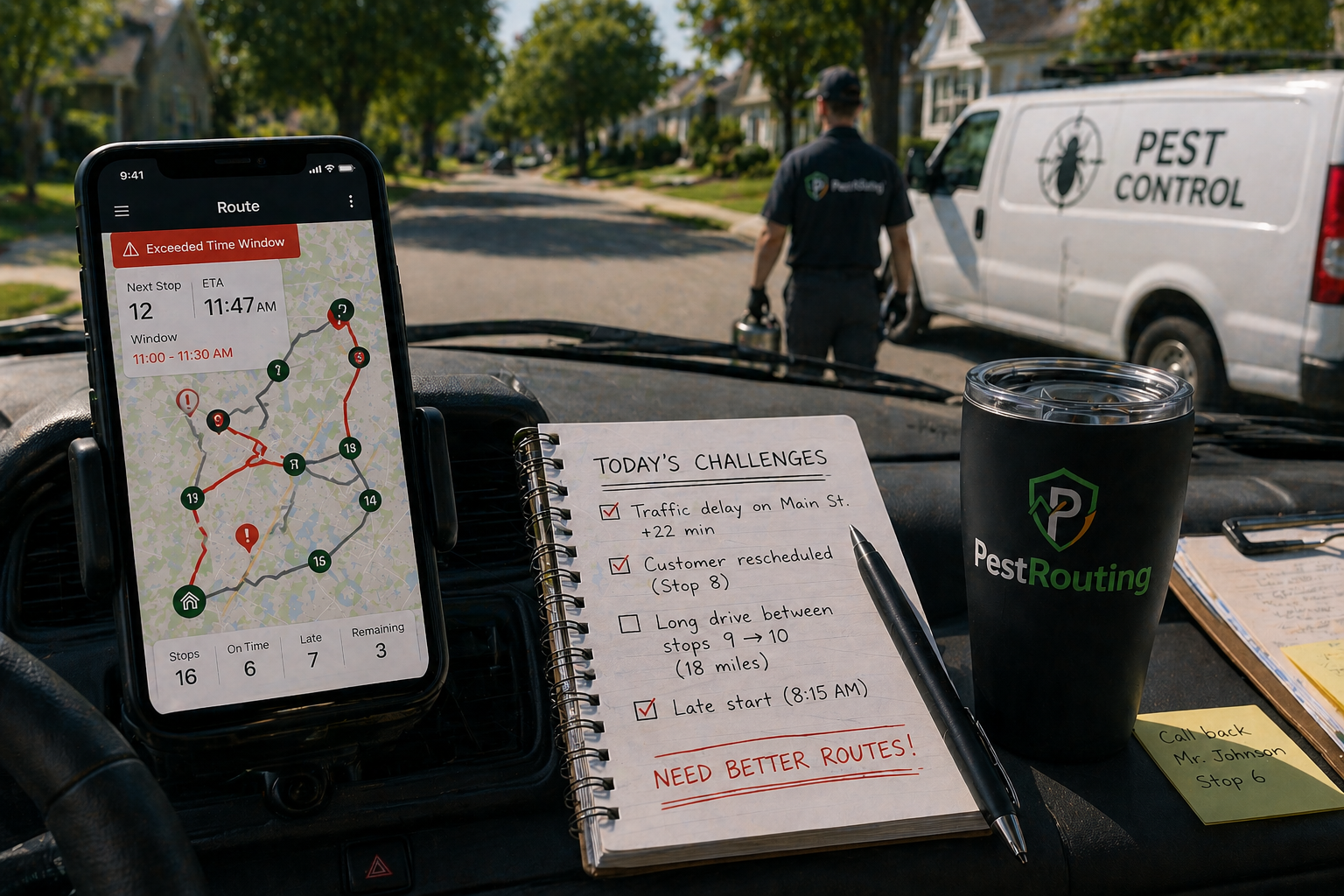
The Difference Between Busy Routes and Profitable Routes
A full route is not a profitable route. Revenue per service hour, drive time share, and callback rate decide whether your busiest techs actually make money for the business.
The pest control industry rewards being busy. Full calendars feel like proof that the business is working. Trucks rolling all day feels like proof the team is productive. The dispatcher who keeps every slot full looks like a hero.
None of those signals correlate as cleanly with profitability as owners assume. A route that finishes 18 stops at 6:45pm with 41% of paid hours in the truck is busy. It is also losing money on every additional account it adds. The owner who treats it as a model for the rest of the operation is institutionalizing the wrong pattern.
Four metrics separate busy from profitable. Until those metrics are on the leadership dashboard, "busy" is the proxy that gets defended — and the wrong routes get scaled.
Why "busy" became the default proxy for "good"
Busy is easy to see. Profitable is not.
Stop counts show up on every report. Calendar density is visible at a glance. Tech hours are in payroll. Revenue lands in the books. Owners and dispatchers can read those numbers without specialized analysis.
Profitability per route requires combining four signals that no standard report puts on one screen: revenue per service hour, drive-time share, callback rate per zone, and recurring continuity. Without those four together, "busy" becomes the only available proxy — and proxies drift over time.
The decision risk: When busy is the proxy, the busiest routes get protected and replicated. When profitable is the proxy, the profitable routes get protected and the busy-but-leaking routes get fixed. Different proxies, different operational decisions, different five-year outcomes.
The four metrics that separate busy from profitable
Each of the four answers a different question that "stops served" cannot.
- Revenue per service hour — does the route actually generate enough revenue per productive hour to cover its loaded cost and contribute margin?
- Drive-time share — what percentage of paid hours is the tech in the truck instead of at a customer site generating revenue?
- Callback rate per zone and tech — how often does the route generate rework that consumes a future productive hour?
- Recurring continuity — what share of recurring accounts on the route are served by the same tech each visit?
Together, these answer "is this route making us money or just keeping us moving?"
Revenue per service hour, the master KPI
If only one number gets watched, this is the one. Revenue per service hour is total billable revenue divided by total productive (on-site) hours for the route.
According to the U.S. Bureau of Labor Statistics (May 2024 OES data), fully loaded pest control technician compensation runs around $30 per hour. The break-even revenue per service hour, accounting for vehicle, insurance, materials, and overhead allocation, typically lands in the $90-120 range depending on company size and service mix. Below that, the route is structurally unprofitable regardless of how busy it looks.
Most pest control operations have routes spread across a wide range — some at $70/hour (losing money), some at $160/hour (highly profitable), and the average masks the bimodal distribution. The audit work is not raising the average. It is identifying the underwater routes and either restructuring or releasing them.
How drive time silently kills route P&L
Drive time is the largest single cost variable in a pest control route. Every percentage point above the geographic baseline is unrealized revenue.
The math: a route with 32% drive-time share running 8 paid hours has 5.4 productive hours. The same route at 22% drive-time share has 6.2 productive hours — 15% more productive capacity, same payroll. At a $100/hour productive revenue rate, that is $80 of additional contribution per route per day, or roughly $20,000 per route per year.
Busy route, low profit
18 stops, 8.5 paid hours, 38% drive-time share. Revenue per service hour: $82. Looks productive on the dashboard. Loses money against the loaded cost line.
Lean route, high profit
15 stops, 7.5 paid hours, 19% drive-time share. Revenue per service hour: $128. Looks like an "easier" day. Generates 2-3x the contribution margin.
Callback rate as a margin destroyer
Every callback consumes a future productive hour without generating new revenue. The compounding cost is significant.
The National Pest Management Association consistently identifies first-call resolution as one of the strongest correlates with pest control retention and margin. A route running a 12% callback rate is essentially carrying a 12% margin tax on every billable hour — first by the cost of the rework itself, then by the lost capacity that could have served new accounts.
Callback rates by zone and tech are usually a routing signal, not a service-quality signal. Callbacks concentrated on the last 90 minutes of overloaded routes mean the route is too long, not that the tech is undertrained.
How to rank your routes by real profitability
Pull the four metrics for every route over a 90-day window. Plot revenue per service hour against drive-time share. The four-quadrant matrix reveals the real picture.
Quadrant A (high revenue per hour, low drive time) is the model — replicate. Quadrant B (high revenue per hour, high drive time) needs density work. Quadrant C (low revenue per hour, low drive time) needs pricing or service-mix changes. Quadrant D (low revenue per hour, high drive time) is structurally underwater and usually needs to be restructured or the underlying accounts repriced.
For the deeper math, the breakdown of maximizing revenue per service hour in pest control walks through the calculation. Our deep dive on route density vs route distance covers the drive-time mechanics. And the post on increasing stops per route ties the productivity question back to operational discipline.
Frequently asked questions
How is revenue per service hour different from revenue per route or revenue per tech?
Revenue per route can look healthy on a long, busy day even when the productive time is low. Revenue per tech is a payroll-level metric that hides intra-route waste. Revenue per service hour normalizes for productive time and is the cleanest indicator of whether the route is profitable on a per-hour basis — which is the unit that actually matters for capacity decisions.
What is a healthy drive-time share for a residential pest control route?
For dense suburban routes, 18-25% is achievable. For mixed suburban-rural geographies, 22-30% is typical. Above 30% sustained, the route has structural inefficiency that is consuming margin every day. Below 18% sustained, the route is unusually well-clustered and worth studying as a model.
Should we drop unprofitable routes immediately?
Almost never as a first move. Most "unprofitable" routes are recoverable through density improvement, repricing, or recurring schedule restructuring. The exception is structurally remote accounts where geography is the constraint — those usually need distance pricing, account release, or both.
How do we measure callback rate at the route level?
Tag every callback with the original route day and tech in FieldRoutes (or your platform of choice), then aggregate by route over a rolling 90 days. Callbacks per 100 stops is the cleanest metric. Anything above 8% on a recurring residential route deserves a closer look at sequencing, service times, and tech rotation patterns.
Can a route be busy and profitable at the same time?
Yes, and those are the routes worth scaling. Busy and profitable means high stop count, high revenue per service hour, low drive-time share, and stable callback rate. The pattern is real, but it is far less common than the dashboards suggest. Most "busy" routes are busy and marginal — not busy and profitable.
How quickly can we improve route profitability through these metrics?
The first 5-10% of revenue-per-service-hour improvement typically lands in the first quarter after the audit (territory cleanup, recurring re-anchoring, drive-time reduction). The remaining lift is incremental over 2-4 quarters as the operation absorbs the new patterns and pricing decisions roll through the customer base.
Written by
PestRouting Team
Practical guidance on pest control route optimization, scheduling, and operational efficiency.
Liked this? Get the same analysis on your routes.
30 minutes. We listen first. Then you decide if a real audit makes sense. No pitch, no pressure.
