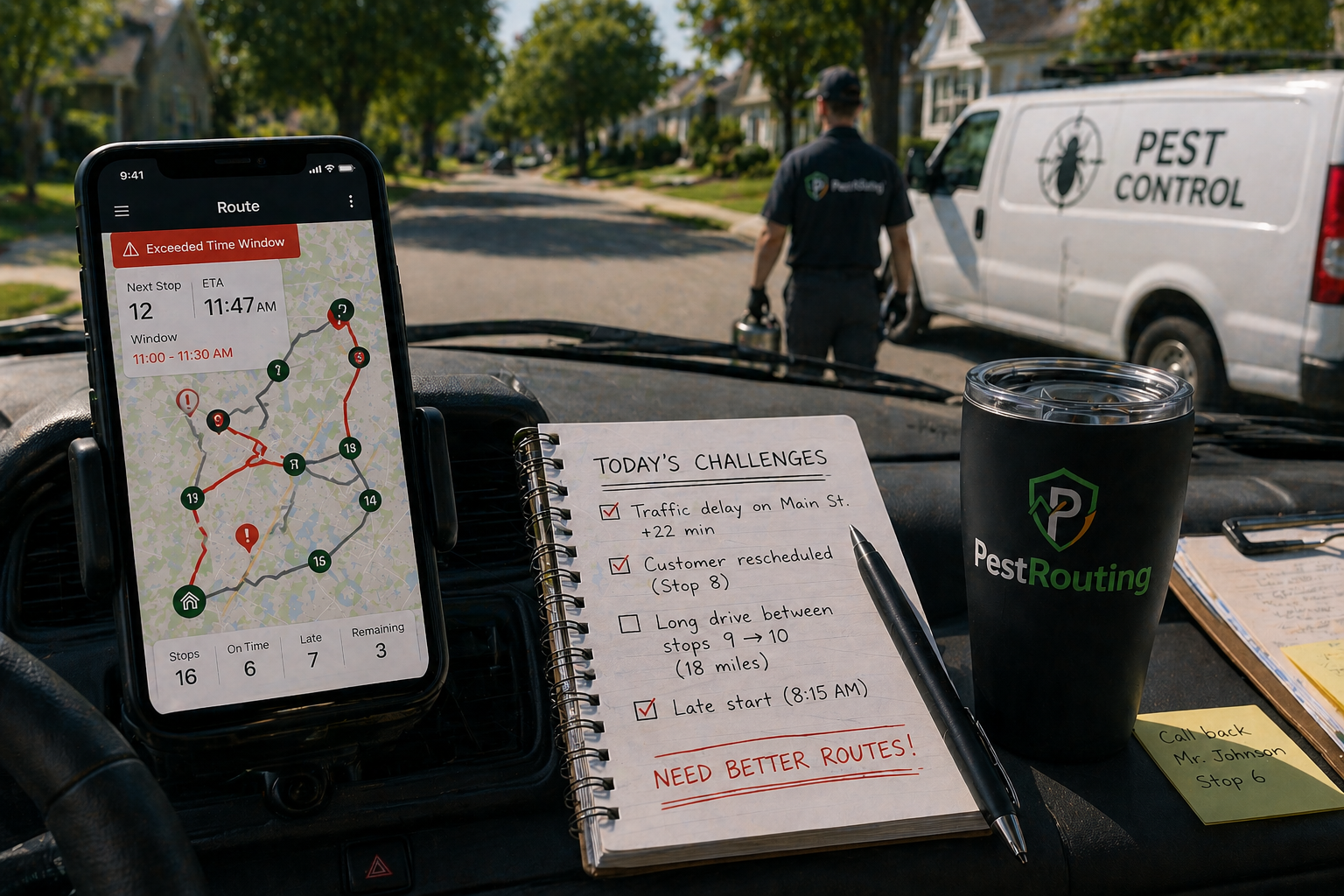
Field Readiness in Pest Control: The Pre-Visit Checklist That Protects Technician Productivity
Many route delays start before the first treatment begins. Field readiness protects technician productivity by making sure every visit reaches the route with the right information, materials, and access plan.
Last updated on April 5, 2026.
Many route delays are blamed on traffic, customer timing, or technician pace. In reality, a surprising amount of route waste starts before the first treatment begins. Missing gate notes, unclear scope, wrong materials, incomplete service history, or weak access instructions all force technicians to spend field time solving problems that should have been solved before the truck moved.
That is why field readiness matters. It is the pre-visit discipline that determines whether a scheduled stop arrives in the field as a ready job or as a live puzzle. Strong teams protect technician productivity by making sure the route is operationally complete before the technician reaches the first address.
| Field-readiness metric | What it reveals | Why it matters |
|---|---|---|
| Stops with missing access notes | How often technicians arrive without entry clarity | Access confusion creates idle time and late-route drift. |
| Material mismatch rate | How often the route reaches a stop without the right supplies | Stock errors create avoidable return trips and weak first visits. |
| Service-history lookup time | How much field time is spent reconstructing context | That is office work being paid for at field rates. |
| Pre-visit contact failure | Whether customers and technicians are aligned before arrival | Weak contact discipline increases no-shows and delays. |
Field readiness turns route time into service time
Technician productivity is not only about how fast a stop is completed. It is about how much of the route day is actually available for productive service instead of clarification, searching, waiting, or backtracking. Field readiness improves that ratio by pushing avoidable uncertainty out of the route and back into pre-visit workflow where it belongs.
This is why field readiness is closely tied to stops per route. Recovering productive minutes is often less about asking technicians to move faster and more about making sure they do not lose 5 to 10 minutes at multiple stops solving problems that should have been handled in advance.
Key insight: A route becomes more productive when fewer field minutes are wasted on preventable questions, missing context, and incomplete prep.
What a field-ready stop should include
A field-ready stop is not just a date and an address. It should arrive on the route with the minimum information needed to perform confidently.
- Confirmed access instructions: gate code, key arrangements, pet notes, locked-yard guidance, or commercial point-of-contact details.
- Clear scope of work: whether this is recurring service, an initial, a callback, or a specialist follow-up.
- Recent service context: last treatment notes, unresolved issues, and previous recommendations.
- Material and equipment readiness: the route has the right products and tools for what the board says is coming.
- Customer communication status: reminder sent, confirmation received if required, and any known timing or access change visible before arrival.
When one of those pieces is missing, the technician becomes the backup operations team. That is expensive and unnecessary.
Field-readiness failures are paid for at field labor rates
The BLS wage benchmark makes the labor issue obvious. Every minute spent figuring out missing details in the field is technician time with a real cost. The IRS mileage benchmark adds the route cost whenever incomplete prep causes extra movement, return trips, or dead time between stops.
The point is not that office work is free. It is that it is usually cheaper, calmer, and more scalable to solve these problems before the day starts than to solve them from a truck in the middle of a live route.
Customer communication is part of field readiness, not a separate function
Teams sometimes treat reminder messages, access confirmation, and ETA discipline as customer-service features only. Operationally, they are field-readiness tools. A stop is not ready if the customer has no idea the service is coming or if the route does not know about a changed access condition.
That is why no-show prevention and route readiness belong together. A missed reminder or unconfirmed access note can turn a normal appointment into wasted technician time even when the route design itself was strong.
FieldRoutes' software overview highlights reminders, mobile access, and service visibility as part of the operating stack. Their value is highest when they reduce uncertainty before the route starts rather than merely documenting what went wrong afterward.
The route should not discover missing scope in real time
One of the most expensive field-readiness failures is scope confusion. A stop is booked as recurring service but actually behaves like an initial. A callback shows up without clear previous notes. A commercial account requires access coordination that never reached the route. These are not technician errors. They are pre-visit design failures.
This is where a route-ready checklist beats improvisation. If the business forces every scheduled job to pass a small set of readiness checks before it can fully commit to the route, a large share of avoidable drift disappears.
A practical field-readiness checklist
| Checklist item | Question to ask | Why it protects the route |
|---|---|---|
| Access ready | Can the technician actually reach the property? | Prevents idle arrival and same-day confusion |
| Scope clear | Does the route know what kind of work this really is? | Protects duration assumptions and material prep |
| History visible | Can the technician see what happened last time? | Reduces repeated diagnosis and field guesswork |
| Materials staged | Is the truck prepared for this work mix? | Prevents unplanned yard returns and delays |
| Customer aligned | Has the customer been reminded or confirmed if needed? | Reduces no-shows, lockouts, and surprise friction |
A 30-day field-readiness reset
Track the top five pre-visit failures for two weeks
Look for missing access notes, scope errors, stock issues, unclear service history, and customer communication misses.
Build a route-ready checklist
Require every scheduled stop to pass a small set of readiness checks before it fully commits to the board.
Audit recurring stops with repeated prep failures
If the same accounts keep creating field confusion, fix the account record or service process rather than letting the route relearn it every cycle.
Review route drift caused by missing prep weekly
Field-readiness problems should be visible in late finishes, callbacks, and wasted minutes, not hidden as isolated anecdotes.
Field readiness is one of the most underused productivity levers in pest control. It protects the route by making sure technicians spend their day treating problems, not reconstructing missing information.
Frequently asked questions
What is field readiness in pest control?
Field readiness means a scheduled stop reaches the route with clear scope, access instructions, customer communication status, recent history, and the right material plan already in place.
Why does field readiness matter for route productivity?
Because missing information and incomplete prep consume field minutes that should have been service minutes. A well-prepared stop protects both technician time and route flow.
What is the most common field-readiness failure?
Missing access or scope clarity is usually the biggest failure. Those issues create immediate delay because the technician cannot start confidently on arrival.
How can a pest control company improve field readiness quickly?
Track the most common pre-visit failures for two weeks, then build a simple route-ready checklist that every stop must pass before it is fully committed to the route.
Written by
PestRouting Team
Practical guidance on pest control route optimization, scheduling, and operational efficiency.
Liked this? Get the same analysis on your routes.
30 minutes. We listen first. Then you decide if a real audit makes sense. No pitch, no pressure.