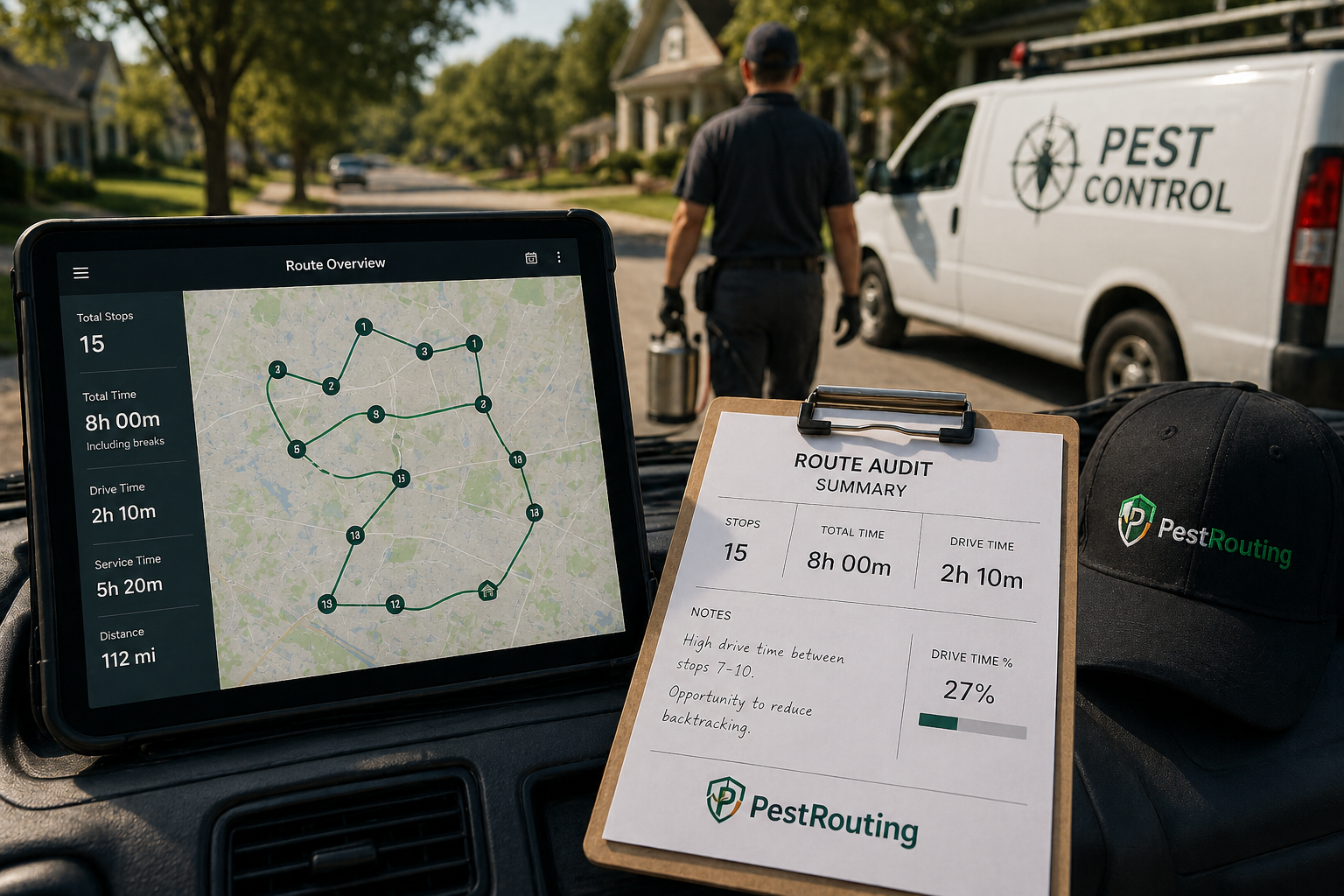
What a Pest Control Route Audit Actually Reveals
Most pest control owners assume their routes are fine because techs finish their days. A real route audit shows the gap between finished and efficient.
Most pest control owners check the wrong number to decide whether their routes are healthy. They look at whether technicians finished their stops by end of day. If yes, the routes look fine. If no, the routes look broken.
The first thing a serious route audit surfaces is the gap between finished and efficient. A route that finishes at 5:47pm with three callbacks queued for next week, a tech who drove 73 miles, and four stops in territories owned by other techs is technically "completed." Operationally, it is bleeding margin every hour it runs.
Here is what an actual audit puts on the table — and why most of it never surfaces in a standard FieldRoutes report.
Why finished routes can still be broken
The pest control industry runs on completion rates because they are easy to measure. Stops served, jobs closed, customers signed. None of those metrics tell you whether the work was profitable, whether the customer experience was consistent, or whether the operation can absorb more growth.
According to the U.S. Bureau of Labor Statistics (May 2024 OES data), the median pest control technician hourly wage sits around $20.18, with total compensation including benefits closer to $30 per hour. Every unproductive hour is a real number on the P&L. Drive time, idle time, and rework are not "costs of doing business." They are the operation's largest variable cost line.
A route audit reframes the question. Instead of "did the route finish?" it asks: "what did the route actually cost, and what should it have cost?"
The audit lens: A finished route is not a healthy route. The relevant comparison is the route you ran versus the route you could have run with the same accounts, same techs, and same constraints.
The first things an audit surfaces
Three patterns show up in almost every pest control route audit, regardless of company size.
1. Cross-territory routing. Techs serving accounts that geographically belong to a different territory. Usually starts as a one-off favor — a same-day request, a vacation cover, a senior tech "just helping out." Over time, it becomes the norm. Once 15–20% of stops are cross-territory, route ownership has structurally collapsed.
2. Density loss. The number of stops per mile in a route's primary zone drifts down over months as accounts cancel, move, or get scattered across days. Nobody notices because the route still finishes. Density is the single most powerful predictor of route profitability — when it drops, drive time absorbs the difference.
3. Quiet overtime patterns. Not the dramatic overtime that triggers a payroll review. The 15–25 minutes of recurring overtime per tech per day that costs $2,000+ per tech per year and never gets escalated.
An audit lays these three side by side. Once they show up together, the pattern of operational debt becomes hard to unsee.
Workload imbalance and the silent overtime problem
Most operations carry an invisible workload imbalance. Two or three techs consistently finish late. Two or three consistently finish early. Dispatch knows it. The schedule still loads them roughly the same number of stops per day because that is what the system does by default.
The 15-minute daily overtime per overloaded tech, multiplied by 250 working days, multiplied by a fully loaded labor cost in the $30/hour range, is roughly $1,800–$2,200 per tech per year. Across a five-tech team, that is one full overtime week's worth of payroll quietly leaking out — every quarter.
The audit pulls this out with two charts: planned vs actual completion time per tech, and stop count vs route hours per tech. The imbalance is rarely about effort. It is about how the route was built.
What dispatch sees
Tech A: 18 stops, finished 5:30pm. Tech B: 17 stops, finished 5:45pm. Both look fine.
What the audit sees
Tech A: 18 stops in 12 sq mi, 28 mi driven. Tech B: 17 stops across 31 sq mi, 71 mi driven, 3 of which were cross-territory cover. Tech B is structurally underwater.
Callback clusters as a routing signal
Callbacks are usually treated as a service quality issue. Sometimes they are. More often, they are a routing signal.
An audit maps callbacks by zone, by tech, and by service type. The clusters that emerge tell you whether the issue is product, training, technician consistency, or schedule pressure. A callback cluster concentrated in the last 90 minutes of a route, served by a different tech each visit, is not a quality problem. It is a routing problem dressed up as a quality problem.
The National Pest Management Association consistently ranks first-call resolution among the top operational levers in pest control retention. When callbacks happen because rushed techs cut corners on the last stops of overloaded routes, the fix is in the schedule, not the training plan.
Capacity leakage: paid hours vs productive hours
Every operation has a gap between paid hours and productive hours. The question is how big the gap is and where it lives.
Capacity leakage shows up across four buckets:
- Drive time — the largest single leak in most pest control operations, often consuming 25–35% of paid hours
- Stop-to-stop transition — paperwork, photo capture, billing, customer chat — usually 5–8% of paid hours
- Idle gaps — unscheduled time between stops because the next stop wasn't ready or the route wasn't tight
- Administrative overhead — start-of-day, end-of-day, fueling, restocking
Most owners track only one number — total hours billed — and have no view into where those hours actually went. The audit breaks them apart and shows the leakage as a percentage of the paid week. When drive time is 38% instead of 28%, the audit can quantify exactly how much that is costing in dollars and unrealized capacity.
What you do with the findings
An audit that does not lead to action is a vanity exercise. The output of a route audit should be a short, prioritized list — usually three to five moves, ordered by impact and feasibility. The first three are almost always the same:
- Territory cleanup — restore ownership before optimizing anything else
- Recurring schedule reset — re-anchor the highest-frequency accounts to the right days and techs
- Dispatch rule discipline — same-day cutoffs, exception budgets, and route-impact checks before acceptance
Companies that follow this sequence typically recover one to two technicians' worth of capacity before they hire — the kind of compounding result that pays for the audit a dozen times over. Fleetio's fleet performance research (2024) shows similar patterns across field service: drive-time reduction is the single largest unlocked operational lever in route-based businesses.
For teams ready to look at their own data, our route audit scorecard guide walks through the same diagnostic framework, and the breakdown of cross-territory routing costs shows how the territory-leak problem compounds quarter over quarter. The companion piece on running a territory audit covers the territory-cleanup step in detail.
Frequently asked questions
How long does a pest control route audit take?
A focused route audit usually runs 2–4 weeks end to end: data extract, pattern analysis, owner review, and a prioritized action list. The data work itself is typically a few days; the rest is interpretation and decision-making with the operations team.
What data does a route audit need?
At minimum: completed-stop logs with timestamps and locations, technician assignments per route day, recurring service frequencies, and at least 90 days of history. Drive-time data and callback records improve the audit but are not strictly required for the first pass.
Can a small pest control company benefit from a route audit, or is this only for multi-branch operations?
Smaller operations often benefit more in percentage terms because the impact of fixing a single overloaded tech or one cross-territory leak is concentrated. The math scales down cleanly: the same diagnostic patterns appear at three techs and at thirty.
How is a route audit different from running optimization in FieldRoutes?
Optimization improves the route given the inputs. An audit examines whether the inputs are right — territories, recurring schedules, dispatch rules, capacity assumptions. Optimization on broken inputs makes broken routes faster.
What does a typical route audit cost?
Audit pricing varies by data scope and team size. The relevant comparison is not the audit fee but the recurring monthly cost of the leakage it surfaces — quiet overtime, callback clusters, and capacity loss usually pay back the audit in the first month after the action items are implemented.
Will an audit disrupt our daily operations?
Done correctly, the audit itself is read-only — it analyzes the existing data without changing the schedule. Disruption only comes when the action items are implemented, and the recommended sequence (territory first, recurring second, rules third) is specifically structured to minimize day-to-day impact.
Written by
PestRouting Team
Practical guidance on pest control route optimization, scheduling, and operational efficiency.
Liked this? Get the same analysis on your routes.
30 minutes. We listen first. Then you decide if a real audit makes sense. No pitch, no pressure.
